Between Samples: The Blind Spot in RAS Water Quality
Anders Jorud Meyer, Lead Engineer
Late afternoon you get a message from one of the farm technicians – they mention strange and erratic swimming among the fish. They had noticed the behavioral change earlier the same day but didn’t think too much about it. The fish swim high in the water column, lethargic, gasping for air. The oxygen levels in the tanks look fine, 85%, that’s spot on. And the last water sample, taken the day before said everything was fine. Almost every RAS operator has some version of this story. It's tempting to file it under human error or bad luck. It's neither. It's a structural gap built into how water quality always has been measured.
The Gap Between Two Numbers
Most RAS facilities measure water quality using a combination of methods and tools: continuous probes for dissolved oxygen and temperature, usually one per tank or system. Manual titration or colorimetric kits for ammonia and nitrite, run once a day by hand. And send-off lab samples for everything else, with results arriving 24 to 48 hours later. A person then gathers all of it into a logbook or spreadsheet.
The processes driving that water chemistry — nitrification, respiration, oxygen consumption, CO2 production — run continuously, 24 hours a day. The fish don’t take the weekend off. A grab sample is a single point on the production curve. It reports a value, not a trajectory. Between two samples taken eight to twelve hours apart, a slow drift and a sudden crash can produce the exact same pair of numbers on paper.
““A grab sample tells you the value — not the trajectory.””
It's Not Just When You Measure — It's Where
There's a second, quieter version of the same problem. Water chemistry isn't uniform across a farm. Real gradients exist across tanks, biofilters, and degassers. Finding where a problem originates means comparing values at two different points. But if those two points are read by two different sensors, any difference could be a genuine gradient — or it could simply be calibration drift between instruments. Without a common reference, it’s hard to tell the noise from the signal.
Blue Unit’s Lab Station is built around closing both gaps at once — not by adding more sensors to more locations, but by rethinking how measurement itself is structured. A single, centralized set of sensors draws water sequentially from up to 24 sampling points across a farm. Testing a handful of parameters at each stop: CO2, TIC (total inorganic carbon), dissolved oxygen, H2S, temperature, pH, redox, turbidity, particle count and size, ammonia, nitrite and nitrate. Between each sample, the lines and sensor heads are automatically flushed and cleaned. The cycle runs continuously, 24 hours a day - Like a tireless lab technician always on duty.
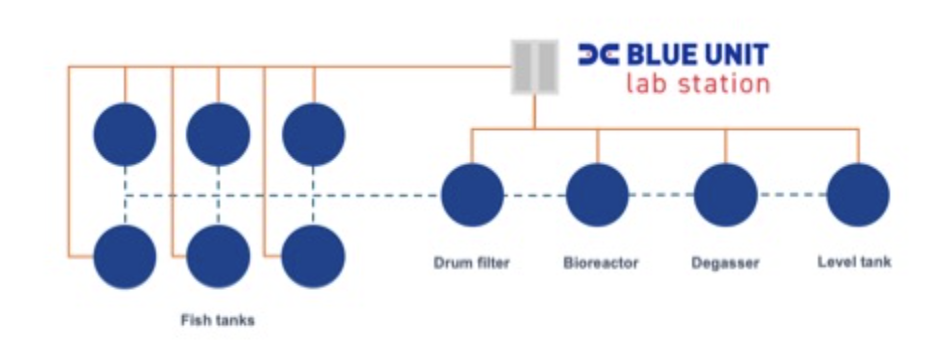
A schematic illustrating the sampling point of Blue Units Lab Station throughout a RAS.
Because the same sensors, with the same calibration and the same drift, make each measurement, a difference between two points becomes a real, trustworthy gradient rather than an artifact of instrument disagreement. A pH drop across a biofilter is no longer a question mark — it's a measurable, comparable signal.
From Checking in, to Watching – Reading Trends Instead of Thresholds
Measuring several locations, on every cycle, turns a series of spot checks into something closer to a continuous line. A drifting parameter shows up as a graph days before the alarms start sounding— and the same logic of gradients catching a failing biofilter can flag overfeeding, degrading feed quality, or a filter quietly losing efficiency, long before it becomes hazardous for the fish. In practice, this shifts the job from reactive to observational:
Alarms stop being the first warning sign — trends become visible days in advance.
Because the measurement method is standardised, farms using Lab Station can be benchmarked against one another, component for component, not simply as isolated numbers.
Conclusion
The instrument reading from earlier that day is not wrong — it just hasn't been asked the right question, in the right place, in a way that can be compared to what came before it. The real shift Blue Unit Lab Station offers isn't a smarter alarm. It's a different relationship to the water: from checking in on it, to watching it.