Do you know your water?
Water is our most precious resource, yet we know too little about it. SmartAkva provides solutions and services securing insight, knowledge, safety and control of the water. The management of water quality is complex and comprehensive data sampling is a must.
High, low and rapid changes of water quality parameter levels can be detrimental for the farmed fish.
How can you tell if the water quality is good for your fish
First, you need to monitor your complete system, not average values of several fish tanks. Each fish tank is its own environment - so you need to measure each unit.
In addition, if you run a RAS farm- you should measure the removal efficiency of the treatment components - to observe if there is a change in removal rates- causing degraded water quality for the new water into the tanks.
Then, you need to know the upper and lower tolerance limits for each specific water parameter.
-
The content of the intake water (make up water)
The pre-treatment of intake water
the discharge from the fish (CO2, NH3, undigested food)
The technology set up for water treatment in the loop
The speed of replacing polluted water in the tank with new and treated water (hydraulic retention time)
Apart from the life-supporting oxygen, the most important water parameter (except the vital need for oxygen) is to control the pH (mostly for RAS farms, but also flow-through farms). The pH controls several water chemical processes that have a great impact of the fish.
Each fish tank has its own environment and, most of all, it's rarely stable. The continuous changes in particles, pH and CO2 have a great contribution to the fish welfare, since the animal always needs to compensate for unfavourable conditions.
The microbiology in the fish farm is important to control. Fuelled by carbon from fish faeces, the microbiome changes rapidly, providing nourishment to bacteria and microorganisms. Fast-evolving bacteria (heterotrophic) may be a source of pathogens and can cause sickness and disease. More stable bacteria (autotrophic) should be selected to obtain stable conditions. Measuring the bacterial activity and diversity provides insight in the system stability.
Fish welfare and vitality is dependent on water quality and thrive under stable conditions. Different farmed fish species have different requirements. Based on your water quality, technical set-up and fish species, SmartAkva gives you deep insight to support responsible decisions.
Sensor technology to monitor
The development of landbased aquaculture is rapid and here are three ways to obtain good control of your farm.
-
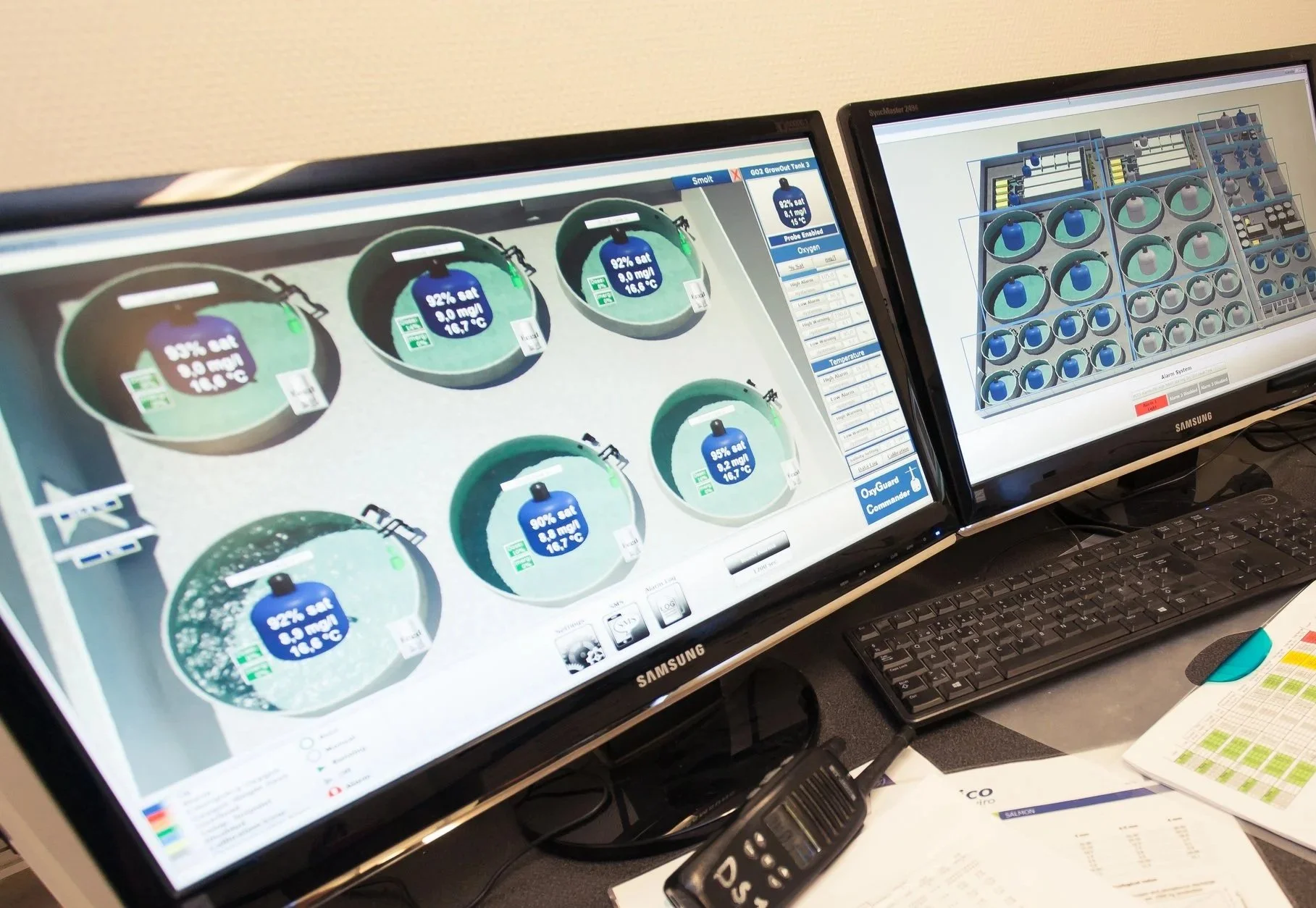
In a commercial RAS farm, the size of the fish tanks and amount of biomass, demands tank-wise measurements to obtain good control of the water chemistry. There are 15 important water quality parameters that should be measured continuously.
-
In addition, the water treatment system in the RAS loop (drumfilter, biofilter and degasser) also should be monitored in order to have control of removal efficiences
-
The microbiome in the system is a footprint of the environmental stability. Rapid changes in the composition of the microbiota indicates system inbalance. Microbiota should be monitored on weekly basis.
THE SOLUTION
How do you monitor water quality in the best way?
SmartAkva provides advanced solutions for real-time water quality and microbial monitoring. Our technology gives fish farmers deeper insight into the complex relationship between water chemistry, RAS performance and fish biology.
From continuous water quality monitoring to microbial analysis and data-driven insight, our solutions help identify changes, understand trends and make better-informed decisions.
Explore our products and discover how SmartAkva turns complex farm data into actionable insight.
Are you in trouble?
Alright, it’s messed up. Let’s make sure it will not happen again!
SmartAkva provides state-of-the-art root cause analysis based on your monitoring data, and we provide a practical understanding for you to take the right actions.
SmartAkva are experienced specialists, science-based and practical problem solvers.
Beyond aquaculture
Water quality is measured to protect public health, preserve aquatic ecosystems, and ensure water is safe for drinking, agriculture, and industry. Monitoring prevents waterborne diseases, tracks toxic contamination, and spots environmental imbalances like dangerous algal blooms before they harm local wildlife.
-
New requlations driven from frequent incidents, pave the way for new needs and requirements to regular water quality monitoring and Testing. Traditional portable kits are still often used for field measurements but increased requirements push also for more automation with IoT sensors measuring 24/7 combined with smart SW applications to give the plant management early warnings on deviations and toxic environment developments.
Follow Standards: Adhere to EU, WHO, EPA, or local guidelines for safe thresholds.
Address Sources: Combat pollution by managing agricultural runoff, wastewater treatment, and industrial discharges.
Public Reporting: Expect that soon the Industry will need to share data with official reporting platforms and communities to drive conservation efforts.
-
Health Crises: Contaminated drinking water causes diseases like cholera or lead poisoning.
Ecological Collapse: Nutrient pollution and low DO devastate fisheries and biodiversity.
Economic Losses: Industries face production losses, downtime, repair costs, and fines for non-compliance.
By investing in regular testing, adopting advanced tools, and enforcing regulations, stakeholders can protect public health, sustain ecosystems, and optimize industrial operations.